Samsung SEO Case Study: Driving Global Organic Growth Through International SEO
Overview Samsung is one of the world’s leading technology and electronics brands, with a diverse product portfolio covering smartphones, tablets, televisions, monitors, home…
Overview
Samsung is one of the world’s leading technology and electronics brands, with a diverse product portfolio covering smartphones, tablets, televisions, monitors, home appliances, wearables, and connected devices. With customers searching for products across multiple countries, languages, and search behaviours, maintaining strong organic visibility at a global scale presents a major SEO challenge.
Samsung’s international SEO strategy demonstrates how a global brand can combine centralized technical SEO, localized content, market-specific keyword targeting, internal linking, and authority building to strengthen organic visibility.
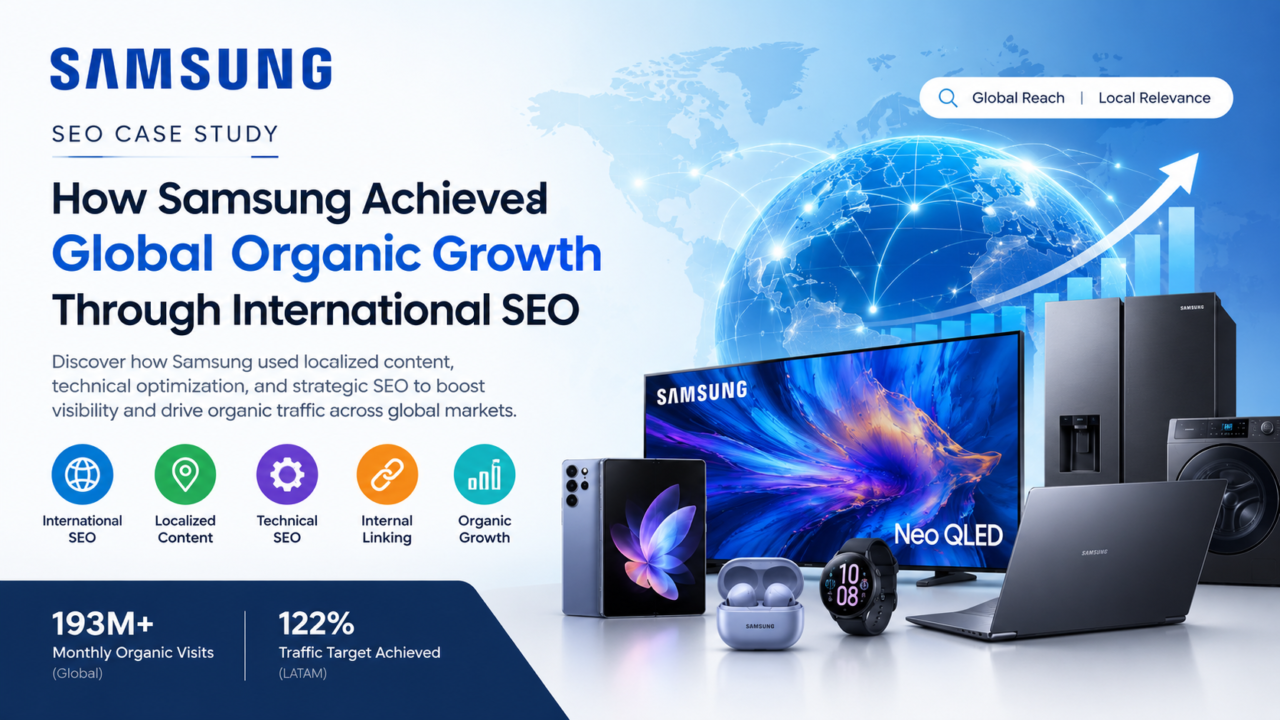
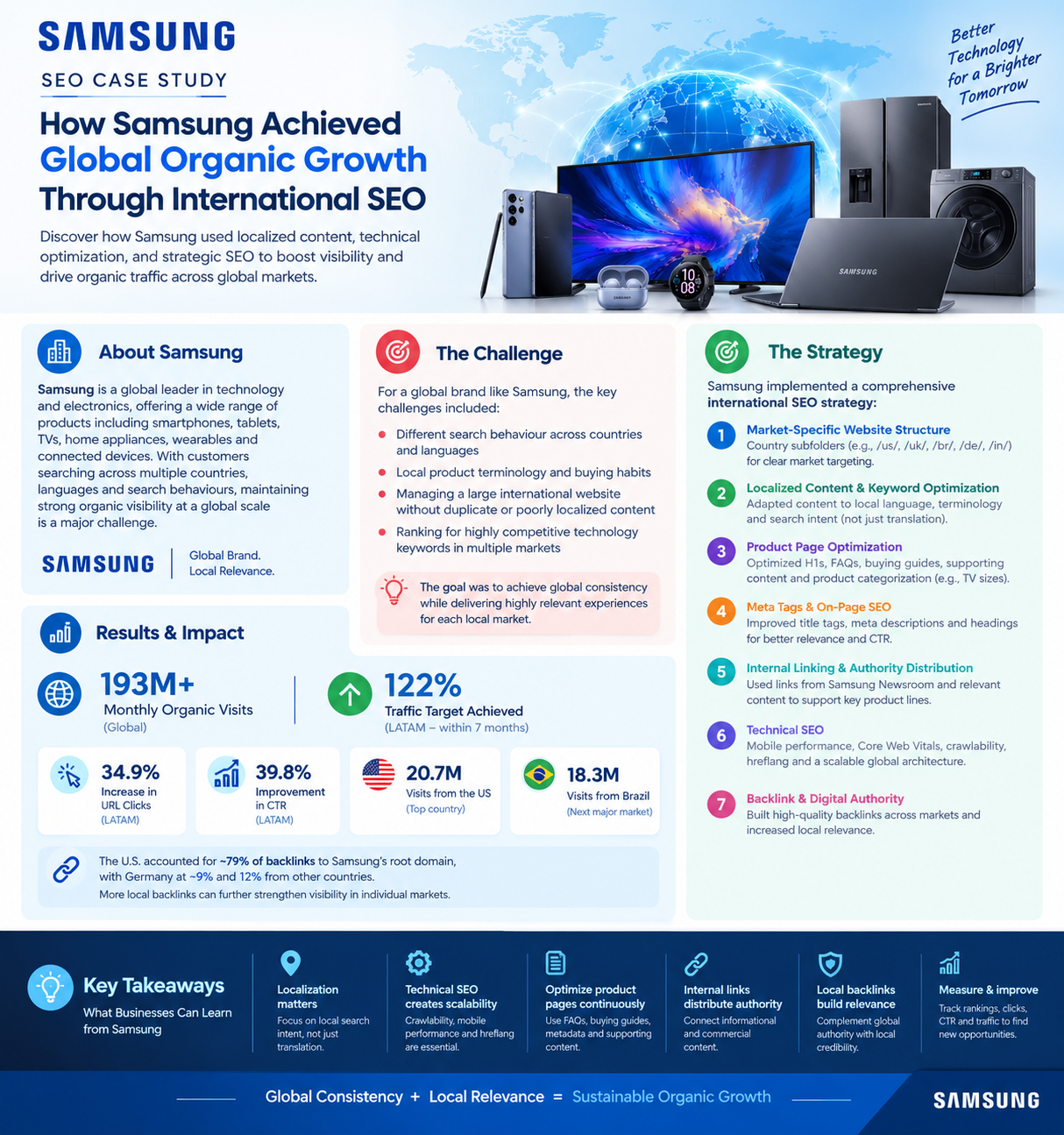
According to an analysis published by upGrowth, Samsung’s international websites generated more than 193 million monthly organic visits, demonstrating the scale that can be achieved through a well-structured international SEO strategy. Separately, Cadastra reported that its SEO work for Samsung LATAM surpassed the annual traffic target by reaching 122% of the projected goal within seven months, alongside a 34.9% increase in URL clicks and a 39.8% improvement in CTR.
The SEO Challenge
For a global organization such as Samsung, ranking for broad, highly competitive technology keywords is only one part of the challenge.
Search be-haviour differs significantly between countries. Customers in India may use different product terms from customers in Germany, Brazil, the United States, or the United Kingdom. Language, purchasing behaviour, product availability, currency, cultural preferences, and local competition can all influence search intent.
Samsung therefore needed an SEO approach capable of achieving two objectives simultaneously:
- Maintain a consistent global brand and technical infrastructure.
- Deliver highly relevant experiences for individual countries and languages.
This required an international SEO framework that could scale across markets without creating duplicate, poorly localized, or difficult-to-crawl content.
International SEO Strategy
- Market-Specific Website Structure
One of the important elements identified in Samsung’s international SEO approach is the use of country-specific website structures.
Examples include country subfolders such as:
- Samsung.com/us/
- Samsung.com/uk/
- Samsung.com/br/
- Samsung.com/de/
- Samsung.com/in/
This structure helps search engines understand which content is intended for a particular market while allowing Samsung to maintain a centralized global domain architecture.
For an international brand, clear URL structures also make it easier to organize localized content, manage internal linking, track performance, and implement market-specific SEO strategies.
- Localized Content and Keyword Optimization
Translation alone is rarely enough for international SEO.
Samsung’s approach focuses on adapting content according to local language, search behaviour, terminology, and market requirements. Localized keyword research allows product and informational pages to target the terms that users actually search for in each region.
This is particularly important for technology products because product names, specifications, features, and buying terminology can vary between markets.
The strategy therefore goes beyond simply translating English content. Content needs to be useful, culturally relevant, and aligned with local search intent.
- Product Page Optimization
Product pages are critical for Samsung because they sit close to the purchasing stage of the customer journey.
For Samsung LATAM, Cadastra reported improvements to product and informational pages, including optimization of H1 headings, FAQs, supporting content, and pages organized by television size. Buying guides were also developed and translated for products such as TVs, soundbars, and monitors.
This type of optimization helps search engines better understand page relevance while providing users with additional information before making a purchase decision.
- Meta Tags and On-Page SEO
Samsung’s SEO efforts also included ongoing monitoring and recommendations for meta titles and descriptions.
Well-optimized title tags and meta descriptions can improve the relevance of search results and encourage users to click through to the website.
The combination of keyword targeting, descriptive metadata, optimized headings, FAQs, and useful supporting content creates a stronger on-page SEO foundation.
- Internal Linking and Authority Distribution
Internal linking was another important component of the Samsung LATAM campaign.
Cadastra reported using links from Samsung Newsroom content to strengthen relevant product lines, including smartphones, tablets, smart TVs, Galaxy AI devices, and SmartThings.
A strategic internal-linking structure helps search engines discover important pages and can distribute authority throughout a large website.
For an enterprise website with thousands of URLs, internal linking is particularly valuable because it connects informational content with commercially important product pages.
Technical SEO at Global Scale
Samsung’s international SEO model also highlights the importance of technical foundations.
The upGrowth analysis identified several elements associated with Samsung’s global SEO architecture, including structured international URLs, mobile performance, Core Web Vitals, and hreflang implementation.
Hreflang is especially important for international websites because it helps search engines understand relationships between different language and regional versions of pages.
A technically sound architecture also makes it easier for search engines to crawl and index a large number of product, category, support, and informational pages.
Backlink and Digital Authority Strategy
Technical SEO and content alone are not sufficient in highly competitive industries.
Samsung benefits from significant global brand authority, while country-specific backlinks can provide additional relevance in individual markets.
The upGrowth analysis reported that the United States accounted for approximately 79% of backlinks to Samsung’s root domain, Germany represented about 9%, and the remaining 12% came from other countries. The analysis also suggested that greater diversification of high-quality backlinks across international markets could create additional opportunities.
For international SEO, this highlights an important lesson: global authority is valuable, but locally relevant authority can further strengthen visibility in individual markets.
Results
Samsung’s SEO performance demonstrates the potential impact of combining global SEO infrastructure with market-specific optimization.
The upGrowth analysis reported more than 193 million monthly organic visits across Samsung’s international presence. Its country-level analysis identified approximately 20.7 million visits for the US and 18.3 million for Brazil, while also highlighting further opportunities in markets such as the UK and Germany.
The Samsung LATAM campaign reported by Cadastra produced measurable improvements:
- 34.9% increase in URL clicks
- 39.8% improvement in CTR
- 122% of the annual traffic target achieved within seven months
These results demonstrate how focused SEO improvements can contribute to significant organic growth, even for an already established global brand.
Key SEO Takeaways
Samsung’s international SEO strategy provides several valuable lessons for enterprise businesses:
- Localization matters: International SEO should focus on local search intent rather than simply translating existing content.
- Technical SEO creates scalability: Consistent website architecture, mobile performance, crawlability, and international targeting are essential for large websites.
- Product pages need continuous optimization: H1s, FAQs, supporting content, metadata, and buying guides can improve both relevance and user experience.
- Internal links distribute authority: Strategic links from high-value informational content can help strengthen important commercial pages.
- Local backlinks matter: Building relevant authority within individual countries can complement global domain authority.
- SEO should be continuously measured: Search performance, CTR, clicks, rankings, traffic, and user behaviour should be monitored regularly to identify new opportunities.
Conclusion
Samsung’s SEO journey demonstrates that successful enterprise SEO is not based on a single tactic. It requires a combination of technical SEO, international optimization, localized content, keyword research, internal linking, content strategy, and authority building.
By combining a scalable global SEO foundation with market-specific execution, Samsung has been able to maintain significant organic visibility across multiple countries and product categories.
The case also highlights an important principle for modern SEO: global consistency and local relevance must work together. Brands that understand how users search in each market-and then build technically strong, useful, localized experiences around those behaviours – are better positioned to generate sustainable organic traffic and business growth.
For businesses looking to expand internationally, Samsung provides a strong example of how SEO can move beyond rankings and become a scalable growth channel.