GEO vs SEO vs AEO: What’s the Difference and Which One Does Your Business Need?

Shivam
5 min read
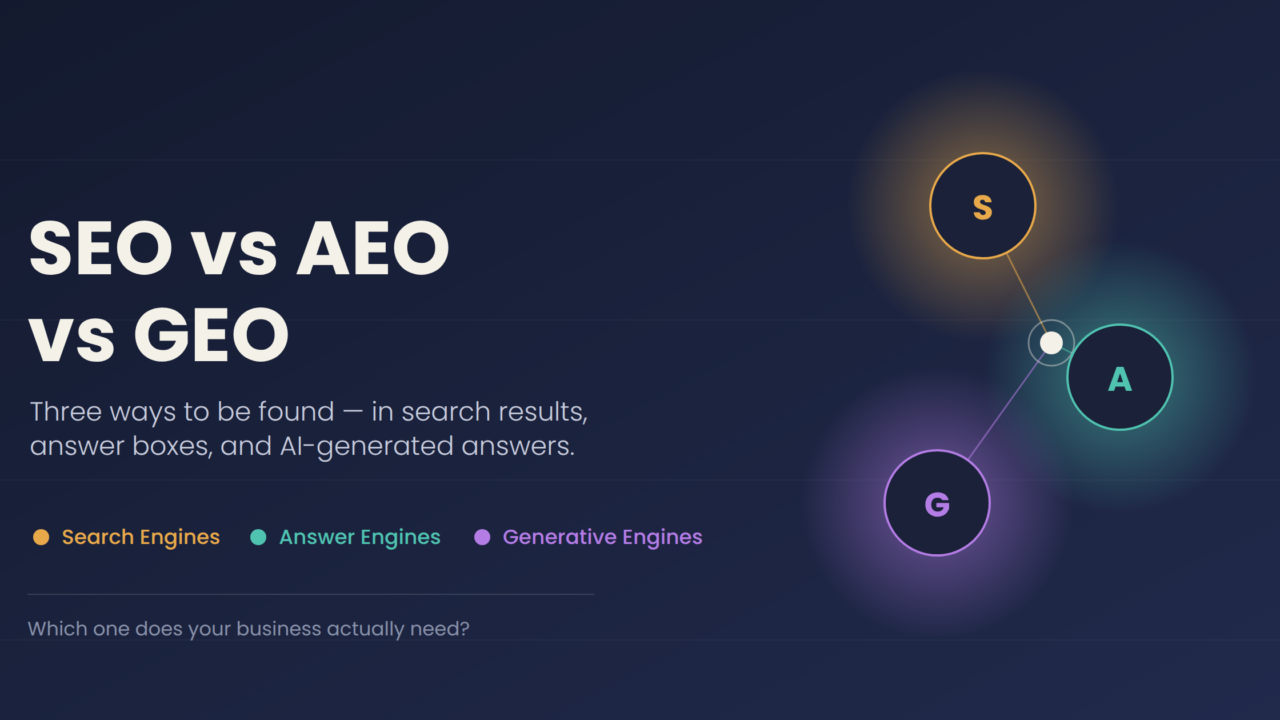
If you’ve been keeping up with digital marketing chatter lately, you’ve probably noticed a new crop of acronyms crowding out the old familiar SEO. Suddenly everyone’s talking about AEO and GEO too, and it’s easy to wonder whether these are genuinely different disciplines or just rebranded buzzwords. The truth is, they’re related but distinct – and understanding the difference matters more now than ever, because the way people find information online is changing fast.
SEO: The Foundation
Search Engine Optimization is the practice you already know. It’s the art and science of getting your website to rank higher on search engines like Google and Bing, primarily by targeting keywords, building backlinks, optimizing page speed, and structuring content so search engines can crawl and index it effectively.
SEO has been the backbone of digital visibility for two decades because it works on a simple premise: people type queries into a search box, and businesses compete for the top spots in a list of blue links. Classic SEO tactics include keyword research, on-page optimization (title tags, meta descriptions, header structure), technical improvements (site speed, mobile-friendliness, schema markup), and off-page efforts like earning backlinks from authoritative sites.
The goal of SEO is clicks – getting a user to land on your page from the search results.
AEO: Optimizing for Answers
Answer Engine Optimization is a more recent evolution, born out of the rise of voice search, featured snippets, and “position zero” results. Instead of optimizing purely to rank in a list of links, AEO focuses on getting your content chosen as the answer – the boxed snippet at the top of Google, the response read aloud by Alexa or Siri, or the “People Also Ask” entry.
AEO leans heavily on structured, concise content that directly answers specific questions. This means using clear question-and-answer formatting, FAQ schema markup, and writing in a way that’s easy for algorithms to lift a direct answer from. Where SEO might optimize a page to rank for “best running shoes,” AEO optimizes a specific passage to answer “what are the best running shoes for flat feet” in a way that can be read aloud or displayed in a snippet box.
The goal of AEO isn’t necessarily a click – it’s being the trusted, quotable answer, even if that means the user never visits your site at all.
GEO: Optimizing for Generative AI
Generative Engine Optimization is the newest of the three, and it exists because of tools like ChatGPT, Google’s AI Overviews, Perplexity, and Claude itself. These generative engines don’t return a list of links or a single snippet – they synthesize information from multiple sources into a conversational, original response.
GEO is about making sure your brand, product, or expertise gets cited, referenced, or represented favorably when an AI model generates that synthesized answer. This involves different levers than traditional SEO: having clear, well-structured, factual content that’s easy for a language model to parse and trust; building genuine topical authority and citations across the web (since generative engines often draw on multiple sources rather than a single top-ranking page); using clear entity definitions and consistent brand information across platforms; and ensuring your content is the kind of thing that gets referenced in the training data or retrieved during a live search-augmented query.
Because generative engines often pull from a blend of sources rather than a strict ranking, GEO is less about beating a single competitor to position one and more about being a consistently credible, citable voice within your space.
The Overlap – and the Key Differences
All three disciplines share a common ancestor: good, clear, authoritative content genuinely helps with each of them. But their end goals differ meaningfully.
- SEO aims to get you clicked on in a search results page.
- AEO aims to get you quoted as a direct answer, often without a click.
- GEO aims to get you referenced or synthesized into an AI-generated response, often without a click and sometimes without explicit attribution.
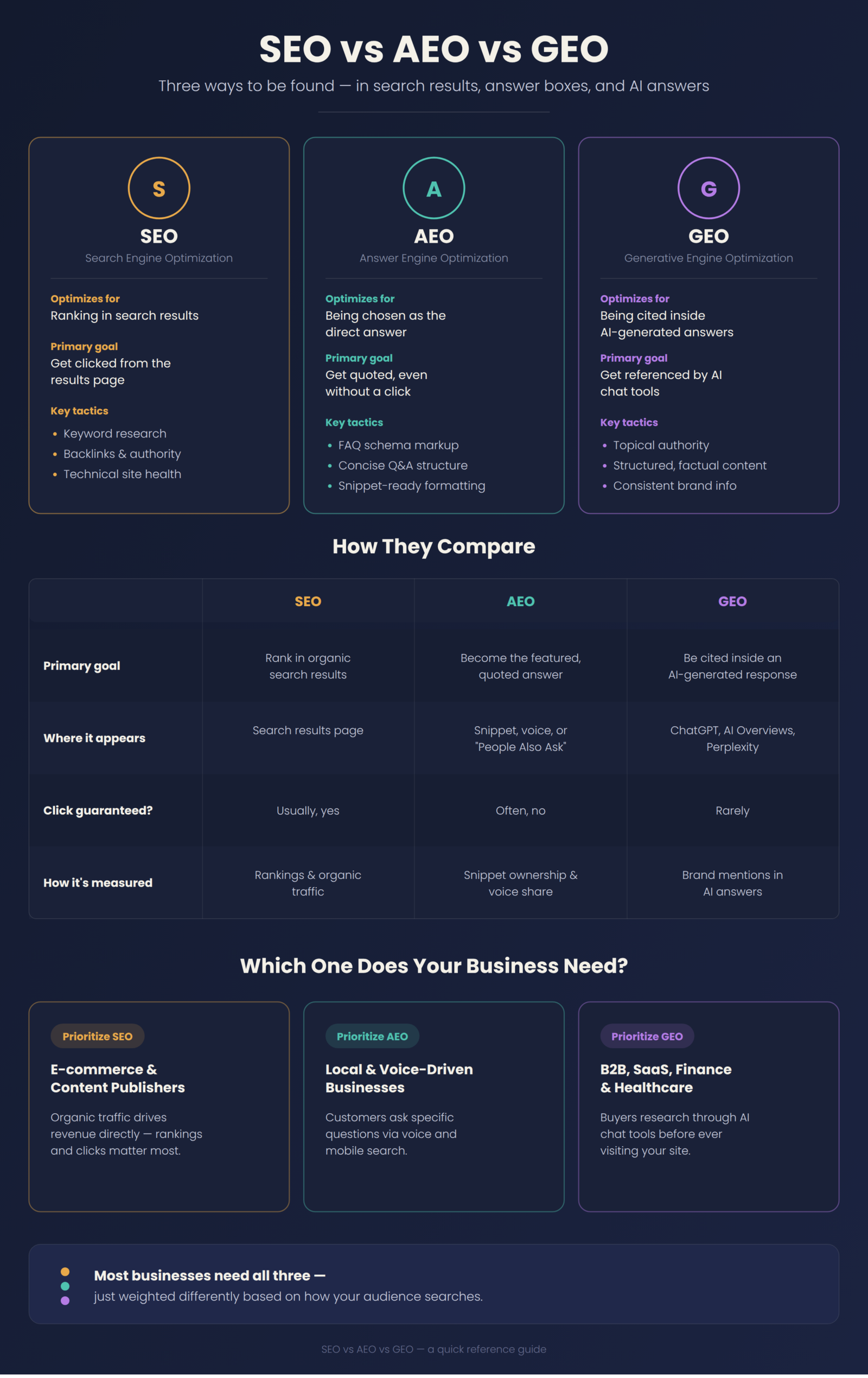
Another key difference is measurement. SEO has mature analytics – rankings, click-through rates, organic traffic. AEO and GEO are harder to measure since a “win” might mean your content shaped an answer without ever showing up in a trackable click. This is pushing marketers toward newer metrics like share-of-voice in AI answers or brand mention tracking across generative platforms.
Which One Does Your Business Need?
The honest answer: probably all three, to different degrees, depending on your business model.
If you rely on organic website traffic to drive conversions – ecommerce, content publishers, lead generation – SEO still deserves the bulk of your investment, since it’s the most measurable and traffic-driving of the three.
If your audience frequently uses voice assistants or searches with specific questions (think local businesses, recipe sites, or How-To content), AEO is worth layering in through structured FAQ content and clear, quotable answers.
If your industry involves research-heavy or comparison-driven decisions – B2B software, financial services, healthcare – GEO is increasingly critical, since buyers are turning to AI chatbots earlier in their research process, sometimes skipping search engines entirely.
The Bottom Line
SEO, AEO, and GEO aren’t competing strategies – they’re overlapping layers of the same broader goal: being visible and trustworthy wherever your audience is looking for answers. The businesses that will win in the next few years are the ones that stop thinking of “getting ranked” as the only finish line, and start thinking about how to earn trust across search results, answer boxes, and AI-generated responses alike.
Frequently asked questions
What is GEO in digital marketing?
What's the difference between AEO and GEO?
Is GEO replacing SEO?
Still have questions? Talk to a strategist →

Written by
Shivam
Search strategist at SeoDotZone writing about SEO, analytics and sustainable growth for Indian and global brands.
Keep reading
-
Lead Generation: The Complete Guide to Attracting and Converting Quality Prospects  SEO
SEOLead Generation: The Complete Guide to Attracting and Converting Quality Prospects
Every business, no matter its size or industry, lives and dies by one core activity: generating leads. You can have the best…
-
Core Web Vitals in 2026: A Practical Playbook for WordPress  SEO
SEOCore Web Vitals in 2026: A Practical Playbook for WordPress
Website speed is no longer just a technical concern—it is an important part of user experience, SEO, conversions, and overall website quality.…
-
What Is GEO (Generative Engine Optimization)? A Complete Guide for 2026  SEO
SEOWhat Is GEO (Generative Engine Optimization)? A Complete Guide for 2026
Search is changing rapidly. People are no longer relying only on traditional search engines to find information. Instead, users are increasingly asking…